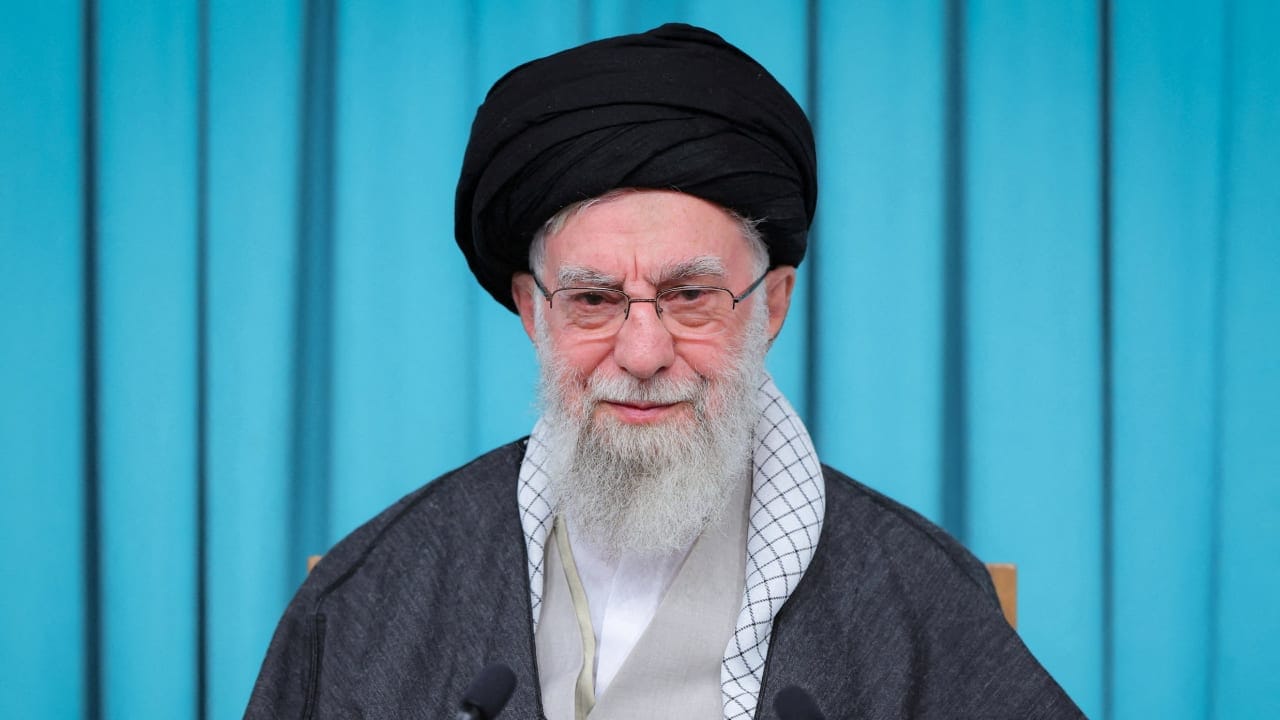
Ayatollah Khamenei Assassinated: A New Dawn for the Islamic Republic?
The news reverberated across the globe on Sunday, marking a seismic shift in Middle Eastern geopolitics: Ayatollah Ali Khamenei, Iran’s Supreme Leader for over three decades, has been assassinated in a series of targeted US-Israeli strikes in Tehran. Iranian state media confirmed the unprecedented event, detailing that several members of his immediate family – including his daughter, grandchild, daughter-in-law, and son-in-law – were also tragically killed in the coordinated attacks. This audacious act of military precision against the Islamic Republic's highest authority signals the abrupt end of an era and catapults Iran into a period of profound uncertainty, setting the stage for a potentially dramatic reshaping of its domestic and international trajectory. The implications of this iran leader assassination are vast, touching upon regional stability, global power dynamics, and the very future of the Iranian state.
The Final Hours: Confirmation and Immediate Fallout
The sequence of events leading to the confirmation of Khamenei’s death unfolded rapidly. Earlier on Saturday, Iranian officials had hinted at releasing a recording from the Supreme Leader, following initial reports of Israeli strikes targeting his Tehran compound. The preliminary assessment among Israeli officials was that Khamenei had been injured. However, the situation escalated dramatically. US President Donald Trump, in a striking social media post, affirmed his belief that Khamenei was killed on Saturday. This was corroborated by Iranian state television on Sunday, which confirmed the death of the 86-year-old ruler, whose tenure was one of the longest in modern history.
Israeli Prime Minister Benjamin Netanyahu, in a televised address, stated there were "growing indications" of Khamenei's demise, though he refrained from providing specific details. Documentation purportedly showing Khamenei’s body was reportedly presented to Netanyahu, underscoring the gravity and verification of the operation. The precision of the strikes, which also claimed the lives of several close family members, points to a highly sophisticated and deliberately executed mission. The elimination of such a central figure, along with his inner circle, suggests a strategic objective to decapitate the regime's leadership and create a power vacuum at its very core.
An Era Concludes: Khamenei's Three-Decade Reign
Ayatollah Ali Khamenei's rule, spanning from 1989 until his assassination, made him only the second Supreme Leader since the 1979 Islamic Revolution, following Ruhollah Khomeini. His 34-year tenure was characterized by an iron grip on power, navigating Iran through numerous domestic crises, international sanctions, and regional conflicts. As head of state and commander-in-chief of the armed forces, including the elite Revolutionary Guards, Khamenei held an almost unparalleled position. While not a dictator in the conventional sense, he skillfully placed himself at the center of a complex web of competing power centers, wielding the ultimate veto on matters of public policy and hand-picking candidates for key public offices.
For an entire generation of young Iranians, life has been synonymous with Khamenei at the helm. His image adorned billboards across public spaces, and state television meticulously covered his every move, cementing his omnipresence in the national consciousness. His journey to power began in Mashhad in April 1939, leading him to Qom in 1958, where he became a dedicated student of Ruhollah Khomeini. His close ties to Khomeini propelled him through the ranks, serving as president from 1981 before ascending to Supreme Leader after Khomeini’s death. This ascent was not without peril; Khamenei had been the target of several assassination attempts, most notably in June 1981, when a bomb attack left him severely injured and permanently paralyzed his right arm.
The scale of his power and his enduring presence meant that his death, particularly an iran leader assassination of this magnitude, would inevitably unleash profound political, social, and ideological currents within Iran. The Islamic Republic, as constructed and maintained under his watchful eye, now faces an unprecedented existential challenge.
The Echoes of Celebration and the Road Ahead
The news of Khamenei’s death was met with starkly contrasting reactions, particularly from those who have long opposed the Islamic Republic. Exiled Crown Prince Reza Pahlavi, a prominent figure in the Iranian opposition, wasted no time in celebrating the demise. In a post on X/Twitter, he declared, "Ali Khamenei, the bloodthirsty Zahhak of our time, the killer of tens of thousands of Iran’s bravest sons, has been erased from the page of history. With his death, the Islamic Republic has in effect reached its end and will very soon be cast into the dustbin of history."
Pahlavi’s statement also served as a rallying cry to the Iranian people: "Honorable and courageous people of Iran, while this may mark the beginning of our great national celebration, it is not the end of the road. Remain vigilant and prepared. The time for a widespread and decisive presence in the streets is very near. Together, united and steadfast, we will secure final victory and celebrate Iran’s freedom throughout our Ahuric homeland." This sentiment highlights the deep-seated yearning for change among a significant portion of the Iranian populace and suggests that the assassination could ignite widespread public unrest and calls for fundamental systemic transformation. The removal of the Supreme Leader, the ultimate arbiter, removes a critical pillar of the regime's stability, opening the door for both hopeful aspirations and dangerous instability.
Navigating the Succession and Future Leadership
With Khamenei's death, the immediate and most pressing question for the Islamic Republic is succession. Historically, one of his six children, Mojtaba Khamenei, has been frequently touted in recent years as a potential successor. Mojtaba, a mid-ranking cleric, has considerable influence within the Revolutionary Guard and intelligence apparatus, making him a formidable, if controversial, candidate. However, the path to the Supreme Leadership is complex, traditionally involving the Assembly of Experts selecting from among the highest-ranking clerics.
The circumstances of this iran leader assassination—a targeted strike by external powers—will undoubtedly complicate any succession process. It could lead to a highly contentious power struggle among various factions within the clerical establishment, the Revolutionary Guards, and political elites. The prospect of a swift, smooth transition appears challenging given the sudden and violent nature of Khamenei’s departure. The world will be watching closely to see who will lead Iran after US-Israeli strikes, as the choice will define the country's immediate future.
Beyond the immediate succession, the long-term impact on the Islamic Republic's institutional stability and its foundational ideology is profound. Will the regime manage to consolidate power under a new leader, or will the power vacuum lead to internal fragmentation and external pressures exploiting the moment? The assassination undeniably marks Iran's Supreme Leader Khamenei Killed: End of a 3-Decade Rule, but it is also the beginning of an unpredictable new chapter.
Geopolitical Tremors and the Path to a New Iran
The assassination of Ayatollah Khamenei sends shockwaves far beyond Iran's borders. For regional actors like Israel and Saudi Arabia, long adversaries of the Islamic Republic, this event could be perceived as a strategic victory or a dangerous escalation, depending on how Iran responds. For global powers, particularly the United States, it represents a high-stakes gamble with unpredictable outcomes. The potential for regional destabilization is immense, with proxies across the Middle East likely to react, potentially sparking wider conflicts. Practical tips for observing this evolving situation include monitoring:
- Iranian internal stability: Look for signs of widespread protests, government crackdowns, or power struggles within elite factions.
- Regional proxy activity: Observe any heightened actions from groups like Hezbollah in Lebanon, Houthi rebels in Yemen, or various militias in Iraq and Syria.
- International diplomatic efforts: Pay attention to statements and actions from major global powers, particularly concerning de-escalation or intervention.
- Oil markets: Geopolitical instability in a major oil-producing region always impacts global energy prices.
The path to a "new Iran" is fraught with both immense challenges and unprecedented opportunities. The departure of a leader who had so fundamentally shaped the nation for over three decades creates a void that could either be filled by a continuation of the hardline ideology or by forces pushing for reform and greater openness. The aspirations of the Iranian people, particularly the younger generations who have never known another Supreme Leader, will play a crucial role. Their potential to mobilize and demand change could be a decisive factor in whether the Islamic Republic transforms or fragments.
Conclusion
The assassination of Ayatollah Ali Khamenei represents a watershed moment in the history of the Islamic Republic of Iran and the broader Middle East. The audacious US-Israeli strikes have not only removed a towering figure from the global stage but have also plunged a powerful nation into an era of profound uncertainty. As the dust settles, the world watches with bated breath to see how Iran will navigate its immediate succession crisis, the inevitable internal power struggles, and the intensified external pressures. This event has irrevocably altered the regional geopolitical landscape, ushering in a period where the future of the Islamic Republic, and indeed the stability of the entire region, hangs precariously in the balance. The legacy of Khamenei’s three-decade rule has ended with a bang, and the reverberations will be felt for years to come.